
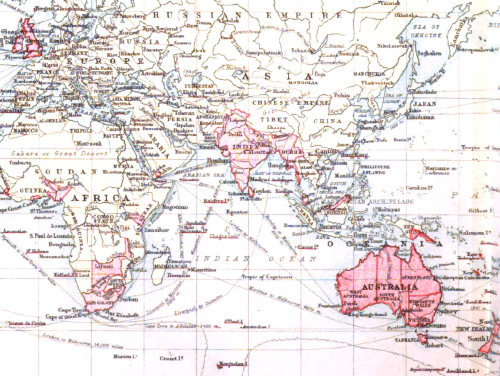
Who actually discovered Australia has been debated for many decades, with today’s historical accounts often simply accrediting the British. However, the following account published in the Royal Atlas and Gazetteer of Australasia in 1890.
It’s editor, John George Bartholomew F.R.G.S. (1860 - 1920) – his family of cartographers famous for many of the world’s earliest maps – summarised the progress of Australia in the following:
 PROGRESS OF DISCOVERY.
The date of the discovery of Australia has long been a disputed point, but recent investigations, coupled with the information derived from old maps, seem to make it clear that the north coast had been sighted, and, at least partly, roughly surveyed by the Portuguese before 1540-probably as early as 1507, or between that year and 1529 - and was then known as Great Java, or Java le Grand.
Quiros named one of his discoveries, made during his voyage of 1605, Terra Australia del Espiritu Sanctu, which was long thought to be Australia, although later investigation appears to point to the New Hebrides as the land seen by that navigator. Be that as it may, it is almost certain that Torres sailed through the strait which now bears his name in the same year as Quiros saw new land, and in 1606 a Dutch vessel penetrated into the Gulf of Carpentaria, and, after visiting Java and New Guinea, sighted Cape York in March 1607.
Dirk Hartog made a running survey of part of the north-west coast in 1610, naming it "The Land of Concord" and was followed, in 1618, by Zaachen, and, in 1619, by Edels, who explored the west coast. Dutch mariners were also the first to sight Cape Leeuwin (1622) and to sail along the south coast (1627), and De Witt is supposed to have visited the scene of those discoveries in 1628.
In 1642 Tasman discovered Tasmania, and shortly afterwards discovered and named New Zealand . Vlaming ascended the Swan River in 1695, and was the first explorer known to us who penetrated inland for any considerable distance. Dampier explored part of the coasts in 1688 and 1699, and a Dutch expedition was on the north west coast in 1705. New Zealand was visited by Captain Cook in the early part of 1769, and in April of the next year he came to Australia in the neighbourhood of Cape Howe, where he hoisted the British flag and took possession of the country on behalf of his sovereign.
King George's Sound was surveyed by Vancouver in 1791, and a French expedition, under Baudin and Freycinet, did some exploring work in 1801. The inland exploration of Australia may be said to have begun by the journey of Governor Phillip in 1788, when he visited Broken Bay.
Next year he discovered and named the Hawkesbury River. The principal later expeditions were undertaken by Grimes (1802); Wentworth, Lawson, and Blaxland (1813); Oxley (1817, 1818, 1823); Hume and Hovell (1824); Cunningham (1827); Sturt, Hume, and M'Leod (1828); Barker (1831); Batman (1835); Grey (1837-39); M'Millan (1839); Stozlecki (1840); Eyre (1840); Stokes (1842); Leichhardt (1844 and 1847); Mitchell (1845); Kennedy (1848); Von Mueller (1853-62); Gregory (1856 and 1858); Stuart (1859, 1860, 1862); Hunt (1864); Forrest (1870, 1874); Giles (1872, 1876, 1882); Warburton (1873); Hodgkinson and Keyser (1875-76); Favenc and Briggs (1878-79); Jack (1880); Watson, Baynes, and Wyatt (1881); Favenc and Crawford, Lindsay, O'Donnell, Mills, Winnicke (1883); Stockdale (1884); Carrington (1885); Lindsay (1885-86); Tenison-Woods (1886); Milman, Lindsay (1887); Favenc and Cuthbertson (1888); Tietkins (1889).
But while much country was made known and opened up by these and other explorers, great part of our knowledge of Australia has been derived from the natural spread of the population in growing districts, and from the "rushes" to the diggings at the time of the gold-fever. Tasman discovered the Fiji Islands in 1643, after which they remained unvisited until Cook made his famous voyages. Bligh passed the group in the Bounty's boat, and Wilson, in the missionary ship Duff, was nearly lost on the Taviuni Reef in 1797.
The United States Exploring Expedition, under Commodore Wilkes, spent some time among the islands, and did much in the way of surveys and mapping, but introduced not a little confusion by the application of new place names, many of which are now forgotten, although several are yet in use.
New Guinea was known to the Spaniards; but when the Dutch became masters of the Indian Seas, their policy of reticence regarding new discoveries or little known places came into play, and its existence was well nigh forgotten, and, even now, comparatively little is known regarding the interior of this important island."